


Crawler Windrow Turner: Tracked Compost Turners for Manure Windrow Composting
Published on: 2026-11-26A crawler windrow turner — also called a tracked compost turner — is a self-propelled compost machine that runs on tracks, straddles long manure rows, and turns, loosens, and mixes the pile as it moves forward. It is the core working machine of a windrow composting machine system, the open-air method of piling organic waste into long rows and fermenting it into stable compost. In a larger compost production equipment line, this manure compost turner sits after raw material preparation and feeds mature compost to screening, drying, or bagging.
Why Every Compost Making Machine Line Needs a Turner
Piled organic waste compacts within days. Without turning, the center turns airless, fermentation stalls, the pile smells, and decomposition stays uneven. A good compost making machine solves this with four jobs in each pass:
Adds porosity and oxygen — loosens the pile so air reaches aerobic bacteria.
Speeds fermentation — keeps microbes active and shortens composting time.
Redistributes hot and cool zones — moves hot inner material outward and brings cool material in, so the whole pile matures evenly.
Mixes and crushes — blends fresh feed with decomposing material and breaks up clumps.
Without a turner, even good raw material produces patchy, smelly compost; with one, the same material matures evenly much faster.
How the Crawler Windrow Turner Works
The working method is simple and repeatable:
Build the windrow first. Stack manure mixed with bulking material into long rows. Row length has no fixed limit; the cross-section is usually trapezoid or triangle so air can enter from the sides.
Straddle the row. The machine drives over the windrow, its body on both sides of the pile.
Turn with the knife drum. A strong rotary drum under the machine carries rotating knives that blend, loosen, and move the compost as the machine advances.
Reshape the row. A hydraulic push plate on the hydraulic crawler turner model reforms material into a regular, neat windrow ready for the next pass.
Fresh material is turned slowly and carefully; more mature material can move faster. One operator runs the machine from the cab.
Crawler Models and Turning Width
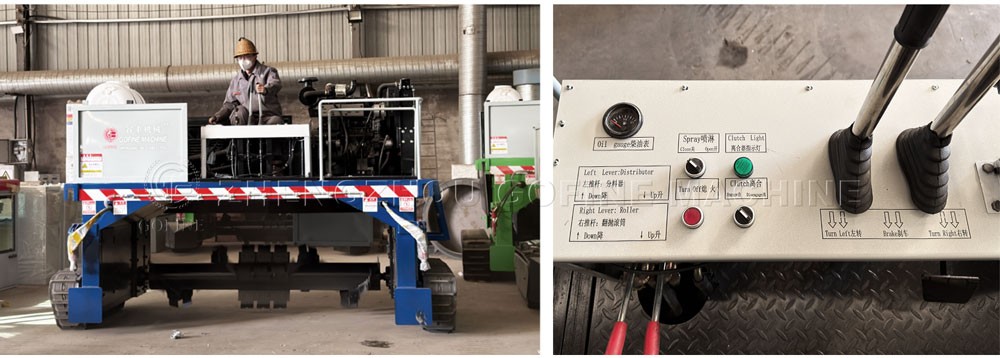
Tracked compost turners come in several models that differ mainly in turning width and turning height. Common widths cover about 2.3 m, 2.6 m, and 3.0 m; choose the model matching your windrow width and pile height, because row size directly affects working efficiency. A crawler turner ferments faster than groove composting and needs no fixed concrete bunkers.
Hydraulic Crawler Turner vs Self-Propelled Compost Turner
Two configurations serve windrow composting, and the choice depends on site and scale:
Hydraulic crawler turner (tracked) — track-mounted, stable crossing the row, fitted with a hydraulic push plate to reshape windrows; suited to larger volumes and heavier outdoor work.
Self-propelled compost turner (wheeled) — a moving, self-propelled machine for turning and mixing organic compost; simpler and suited to smaller or easily accessible sites.
Pick the hydraulic crawler turner for larger rows and heavy duty; pick the wheeled self-propelled compost turner where the site is smaller and level access is easy.
What It Composts and How to Feed It
Suitable materials: chicken, cattle, pig, and sheep manure; crop straw; rice husk; and other organic waste blended with a dry bulking agent. Before building rows, mix fresh manure with straw, sawdust, or husk so moisture sits around 50–60% — damp like a wrung sponge, not dripping. Build the row loose enough for air to enter, turn on a regular schedule, and the pile heats evenly through the organic fertilizer fermentation process.
Common Problems, Simple Fixes
| Problem | Cause | Fix |
Pile smells, never heats | Compacted, airless; too wet | Turn more often; add dry bulking material; check moisture |
Uneven decomposition | Hot and cool zones not mixed | Let the drum fully blend each pass; turn regularly |
Row left messy after pass | Push plate not adjusted | Use hydraulic push plate to reshape windrow |
Machine cannot keep up | Row wider than turning width | Match model width to row; do not overfeed |
Clumps remain in compost | Not crushed during turn | Run knife drum through; pre-break large lumps |
FAQ
What is a crawler windrow turner? A tracked compost turner that straddles manure rows and turns, loosens, mixes, and redistributes the pile to supply oxygen and speed fermentation.
Do I need concrete fermentation trenches? No — windrow composting works on open rows on the ground; the tracked turner moves through them.
How wide a row can one model turn? Models cover about 2.3–3.0 m; choose the width matching your windrow.
Crawler or self-propelled compost turner? Hydraulic crawler for larger rows and heavy duty; wheeled self-propelled for smaller, accessible sites.
Get Your Windrow Turner Quoted
Tell us your daily manure volume, windrow width and pile height, and whether you prefer a hydraulic crawler turner or a wheeled self-propelled compost turner, and we will recommend the matching model with a quotation.
Related Content
Latest News
- Crawler Windrow Turner: Tracked Compost Turners for Manure Windrow Composting
- Ring Die Pellet Mill for Organic Fertilizer Production Line: Buyer Guide
- 1m Stainless Steel Disc Granulator: Small Pan Pelletizer Buyer Guide
- Sulphate of Potash Production Line: Simple Equipment Guide
- BB Fertilizer Production Line for Bulk Blend Fertilizer Plant
- 2.8m Heavy Duty Disc Granulator | Organic Fertilizer Manure Pelletizer
- Automatic Fertilizer Packaging Line | Powder & Granule Bagging, Palletizing & Wrapping
- 3t/h Disc Granulation Fertilizer Production Line | Fertilizer Granulation Equipment